Category: Public Health, Infectious Diseases & Medical Research
Antimicrobial resistance (AMR) is an increasingly important global health challenge. It occurs when bacteria, viruses, fungi, or parasites evolve in ways that make medicines less effective against them. As a result, infections can become harder to treat, illnesses may last longer, and the risk of severe complications and death can increase.
One of the most concerning forms is antibiotic resistance, in which bacteria develop resistance to antibiotics. Misuse and overuse of antibiotics, gaps in infection prevention, limited access to reliable diagnostic testing, and the spread of resistant microorganisms all contribute to the problem.
Research is now exploring faster diagnostic tests, new antibiotics, alternative treatments, improved vaccines, and stronger infection-control systems. The World Health Organization (WHO) has also identified research and development priorities intended to guide action against AMR through 2030.
1. What Is Antimicrobial Resistance?
Antimicrobial resistance develops when microorganisms acquire or evolve mechanisms that allow them to survive exposure to medicines that would normally inhibit or kill them. Resistance is a biological process; it is the microorganisms, rather than the human body, that become resistant to treatment.
Antibiotics act against bacteria, not viruses. Therefore, using antibiotics for illnesses such as the common cold or flu does not treat the underlying viral infection and may contribute to unnecessary antibiotic exposure.
Examples of drug-resistant organisms include methicillin-resistant Staphylococcus aureus (MRSA), drug-resistant Escherichia coli, resistant Klebsiella pneumoniae, and drug-resistant tuberculosis bacteria. Some resistant infections require more expensive treatments, longer hospital stays, or medicines with greater risks of adverse effects.
The WHO reports that approximately one in six laboratory-confirmed bacterial infections worldwide was resistant to antibiotic treatment in 2023. Its latest fact sheet also reports that bacterial AMR was associated with more than 4.7 million deaths globally in 2021. These figures use different years and measures, but both demonstrate the scale of the problem.
World Health Organization
2. Why Is Antibiotic Resistance Increasing?


Antibiotic misuse and overuse
Taking antibiotics when they are not needed, using the wrong antibiotic, or using them without appropriate medical guidance can contribute to resistance. Inappropriate prescribing can occur when antibiotics are given for viral infections or when treatment is not adjusted to laboratory results and clinical findings.
Patients should take antibiotics exactly as prescribed by a qualified healthcare professional. They should not use leftover medicines, share prescriptions, or independently stop, extend, or change a prescribed course.
Inadequate infection prevention
Drug-resistant bacteria can spread through healthcare facilities, contaminated equipment, hands, food, water, and contact between people. Poor hand hygiene, inadequate sanitation, and insufficient infection-control practices increase opportunities for transmission.
Antibiotic use in animals and agriculture
Antimicrobial use in animal health and food production can contribute to the selection and spread of resistant microorganisms. Resistance can move between humans, animals, food systems, and the environment, making coordinated action essential.
Limited access to diagnostics
When reliable testing is unavailable, healthcare professionals may need to make treatment decisions without knowing which organism is responsible or which medicines are likely to work. This can contribute to unnecessary broad-spectrum antibiotic use or delayed effective treatment.
The WHO identifies inappropriate antimicrobial use, gaps in sanitation and infection control, limited access to diagnostics and vaccines, and a weak pipeline of new medicines as important factors driving AMR.
3. Drug-Resistant Infections: Why They Matter
Drug resistance can affect common infections as well as serious illnesses. It can complicate urinary tract infections, pneumonia, bloodstream infections, wound infections, and tuberculosis.
When first-choice antibiotics fail, clinicians may need additional testing and alternative medicines. Some alternatives are more expensive, less readily available, or associated with more side effects. In severe infections, delays in identifying an effective treatment can be dangerous.
AMR also threatens modern medical care. Surgery, cancer treatment, organ transplantation, and intensive care may become riskier when effective antibiotics are unavailable to prevent or treat bacterial complications.
The burden is not distributed equally. Communities with limited access to clean water, reliable laboratories, affordable medicines, and quality healthcare may face greater challenges in preventing and treating resistant infections.
4. Rapid Diagnostic Tests: A Key Research Priority

Rapid diagnostics are an important area of research because they can help clinicians make better-informed treatment decisions earlier in an infection.
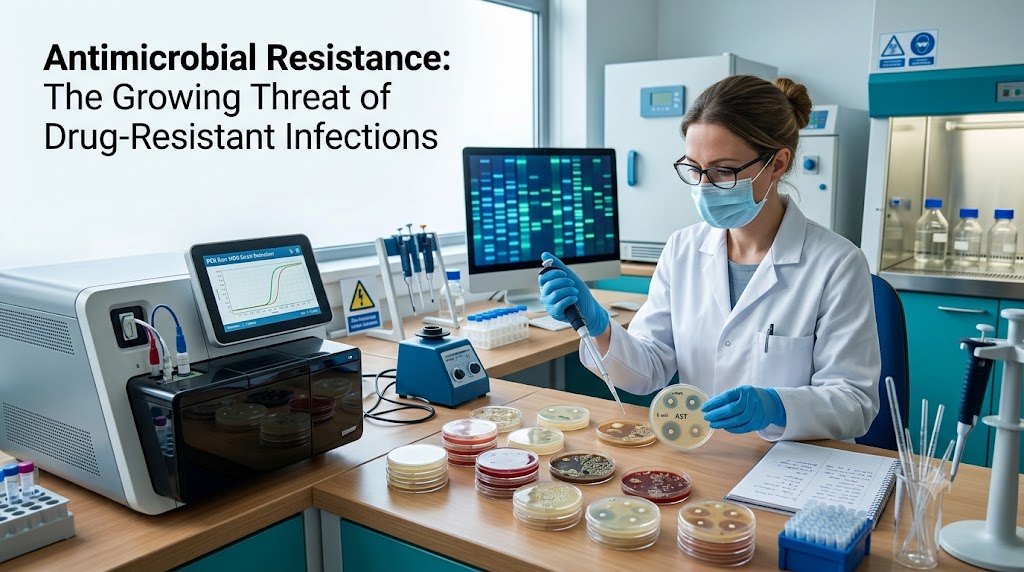
Traditional bacterial culture and antimicrobial susceptibility testing can take time. Rapid molecular methods and other newer technologies may identify pathogens or resistance markers sooner, although turnaround times vary by test, organism, and laboratory workflow.
Researchers are investigating several approaches.
Point-of-care tests aim to help distinguish bacterial from non-bacterial infections near the patient. These tests could reduce unnecessary antibiotic prescriptions when appropriately validated and used alongside clinical assessment.
Molecular diagnostics detect genetic material from pathogens and may identify known resistance genes. However, detecting a resistance gene does not always establish the complete susceptibility profile of an organism.
Rapid antimicrobial susceptibility testing examines whether a bacterium is likely to respond to particular antibiotics. Faster results could help clinicians move from broad initial treatment to more targeted therapy.
Affordable diagnostic platforms are especially important for low-resource settings. Research needs to consider not only accuracy but also cost, maintenance, staff training, electricity requirements, accessibility, and whether test results actually change prescribing decisions.
The WHO’s research agenda specifically highlights point-of-care differentiation of bacterial and non-bacterial infections, rapid pathogen identification, and antimicrobial susceptibility testing.
5. WHO’s Research Priorities for Tackling AMR Through 2030
In February 2025, the WHO published its Global Research Agenda for Antimicrobial Resistance in Human Health. The agenda identifies 40 research priorities: 33 covering bacterial and fungal infections and seven focused specifically on drug-resistant tuberculosis. It is intended to guide researchers, governments, healthcare institutions, and funding organizations toward evidence that can improve prevention, diagnosis, treatment, and public health policy.

Priority 1: Infection prevention
Research on clean water, sanitation, hand hygiene, hospital infection control, and vaccination to reduce infections and the need for antimicrobial medicines.

Priority 2: Faster diagnosis
Develop and evaluate affordable tests that identify infections and resistance patterns quickly enough to support appropriate treatment.

Priority 3: Better treatment and care
Improve antibiotic use, investigate new and existing therapies, optimize treatment regimens, and improve care for people with resistant infections.

Priority 4: Surveillance and policy
Understand how resistance spreads, measure its health burden, improve awareness, and identify policies that work in real-world settings.

Priority 5: Drug-resistant tuberculosis
Investigate improved detection, treatment, and care for people affected by tuberculosis that resists existing medicines.
These areas are interconnected. A new diagnostic test may have little impact if hospitals cannot afford it, clinicians cannot access the results promptly, or effective medicines are unavailable. WHO therefore emphasizes implementation research alongside scientific discovery.
6. New Approaches to Preventing and Treating Resistant Infections
Antimicrobial stewardship
Antimicrobial stewardship means ensuring that patients receive the right medicine, at the right dose, by the right route, for the appropriate duration, with treatment reviewed as clinical information becomes available.
Hospitals can support stewardship through prescribing guidelines, laboratory testing, specialist review, and regular assessment of antibiotic use. Community healthcare facilities can use similar principles to improve prescribing for common infections.
Stewardship is not simply about reducing antibiotic use. Patients with bacterial infections that require treatment must still receive effective medicines promptly.
Vaccination and infection prevention
Vaccines can reduce the number of infections that might otherwise require antimicrobial treatment. Depending on the vaccine and pathogen, they may also reduce transmission and the burden on healthcare services.
Handwashing, safe food preparation, clean water, adequate sanitation, appropriate wound care, and effective hospital infection-control procedures can further reduce the spread of pathogens.
Bacteriophage therapy
Bacteriophages are viruses that infect specific bacteria. Researchers are investigating whether carefully selected or engineered phages can help treat certain bacterial infections, including infections resistant to multiple antibiotics.
Phage therapy is promising in selected research and clinical contexts, but its availability, evidence base, regulatory status, and suitability vary. It is not a universal replacement for antibiotics.
New antibiotics and alternative treatments
Researchers are exploring new antibiotic compounds, combinations of medicines, therapies that target bacterial virulence, and approaches that help existing antibiotics work more effectively.
Other areas include antimicrobial peptides, immune-based treatments, and methods that disrupt bacterial biofilms. Biofilms are communities of microorganisms that can attach to surfaces, including medical devices, and become difficult to eliminate.
The challenge is not only discovering new treatments. Scientists must also establish their safety and effectiveness, ensure equitable access, and reduce the risk that resistance will develop against them.
Artificial intelligence and genomic surveillance
AI-assisted analysis may help researchers identify patterns in resistance data, prioritize potential drug candidates, and investigate how resistant organisms spread. Whole-genome sequencing can help laboratories and public health teams compare bacterial strains and investigate outbreaks.
However, these tools depend on good-quality data, laboratory capacity, and careful validation. AI cannot independently replace clinical judgement or confirm that a medicine will work for an individual patient.
7. Antimicrobial Resistance in India
India has a particularly important role in global AMR research because of its large population, diverse healthcare systems, infectious disease burden, and need for affordable diagnostic and treatment options.
Research and public health action can focus on improving antibiotic prescribing in hospitals and community settings, expanding microbiology laboratory capacity, strengthening infection prevention, and improving access to effective medicines.
India’s National Action Plan on Antimicrobial Resistance provides a framework for coordinated action. A One Health approach is important because resistance connects human health with veterinary medicine, agriculture, food production, and the environment.

Important areas for Indian research include:
- Developing low-cost rapid diagnostic tests suitable for district hospitals and smaller laboratories.
- Improving access to reliable culture and susceptibility testing.
- Studying antibiotic prescribing practices and the reasons for inappropriate use.
- Strengthening infection prevention and control in hospitals.
- Monitoring resistance in humans, animals, food systems, and wastewater.
- Evaluating public education and stewardship programmes in different communities.
Research should also assess whether new interventions are affordable and practical in rural areas and resource-limited facilities. A technology that works in a well-funded research centre may require substantial adaptation before it can be used reliably in a small hospital.
8. What Can Individuals and Healthcare Professionals Do?
Preventing antimicrobial resistance requires coordinated action from individuals, healthcare professionals, hospitals, governments, and the pharmaceutical industry.
Individuals should use antibiotics only when prescribed by an appropriate healthcare professional, avoid sharing medicines, and never use leftover antibiotics to treat a new illness. They should follow the prescribed instructions and consult their clinician before making changes to treatment.
Healthcare professionals can improve prescribing by considering the patient’s symptoms, medical history, local resistance patterns, and available test results. When appropriate, they can review treatment after laboratory results become available and switch to a narrower-spectrum antibiotic.
Healthcare facilities can strengthen hand hygiene, sterilization, environmental cleaning, vaccination programmes, and surveillance of resistant organisms. Governments and research institutions can support public education, affordable diagnostics, laboratory networks, and the development of new treatments.
The WHO’s global strategy also emphasizes responsible antimicrobial use and a coordinated response across human, animal, and environmental health.
9. Future Research Questions
Several questions remain important for researchers working toward the WHO’s 2030 goals.
First, how can rapid diagnostic tests become more affordable and accessible without compromising accuracy? Second, which infection-prevention interventions provide the greatest benefits in resource-limited healthcare facilities? Third, how can researchers encourage appropriate antibiotic use without delaying necessary treatment?
Additional questions concern the long-term effectiveness of new antibiotics, the safety of alternative therapies, the spread of resistant organisms through wastewater and food systems, and the best ways to translate laboratory discoveries into everyday clinical practice.
Researchers should measure outcomes that matter to patients and healthcare systems, including time to effective treatment, treatment failure, mortality, adverse effects, affordability, and the emergence of further resistance.
Conclusion
Antimicrobial resistance is a growing public health challenge that threatens the effectiveness of medicines used to treat bacterial and other infections. Antibiotic misuse and overuse contribute to the problem, but resistance also reflects wider issues involving infection prevention, sanitation, diagnostic access, healthcare quality, and the development of new treatments.
Rapid diagnostic tests, antimicrobial stewardship, vaccination, improved infection control, genomic surveillance, and innovative therapies offer complementary ways to address the threat. None is sufficient on its own; their success depends on reliable evidence, responsible implementation, and equitable access.
The WHO’s 40 research priorities for human health through 2030 provide a framework for addressing critical knowledge gaps. Progress will depend on collaboration among scientists, clinicians, public health authorities, policymakers, and communities.
The central goal is clear: prevent infections wherever possible, use existing medicines responsibly, and develop better ways to diagnose and treat infections that no longer respond to standard therapies.