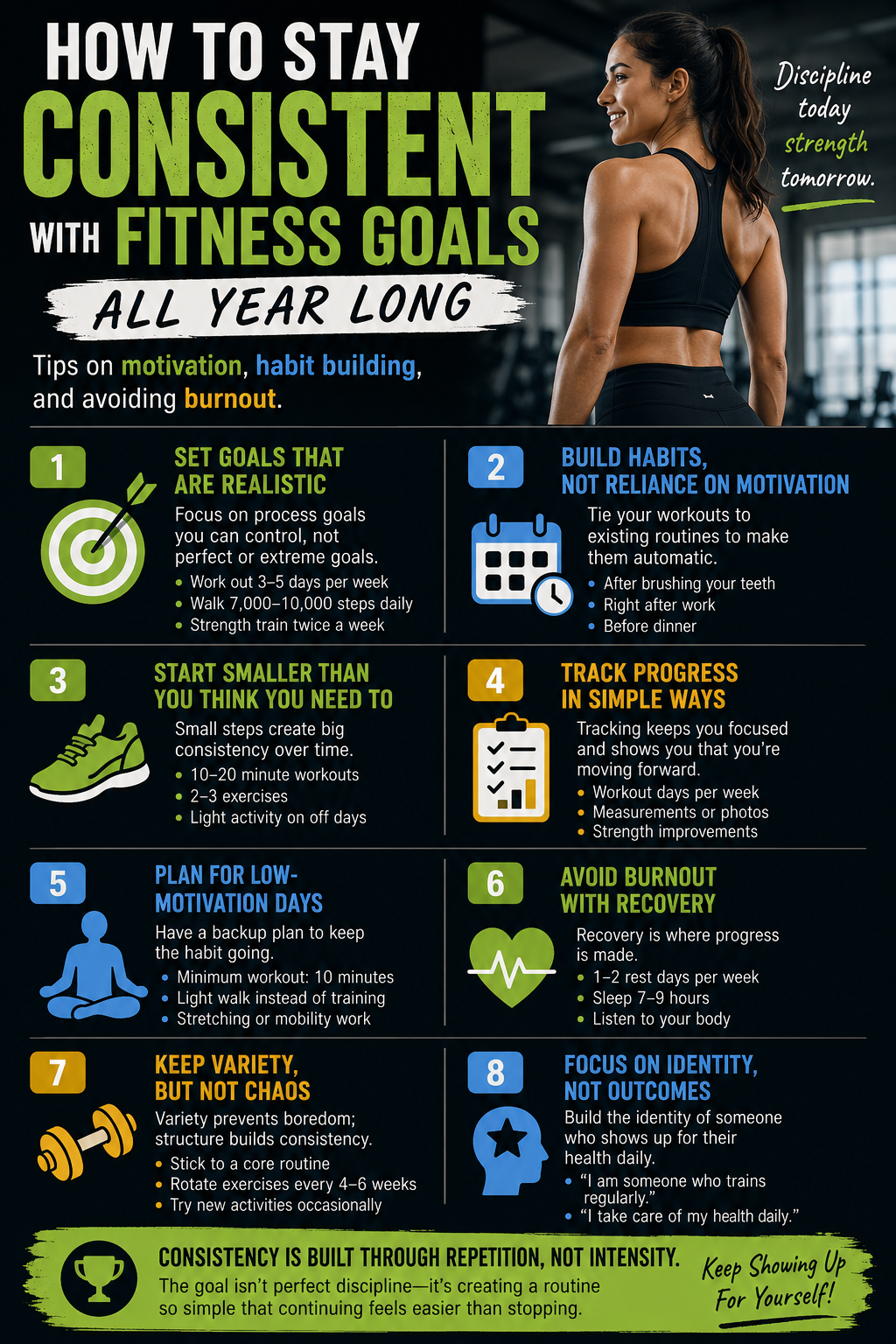
Staying consistent with fitness goals all year long is less about extreme motivation and more about building systems you can repeat even on low-energy days. Here’s a practical way to make consistency feel natural instead of forced.
1. Set goals that are realistic, not dramatic
Big goals like “get fit” or “lose 10 kg fast” often fail because they’re vague or too aggressive. Instead, focus on process goals:
- Work out 3–5 days per week
- Walk 7,000–10,000 steps daily
- Strength train twice a week
When the goal is behavior-based, consistency becomes easier to track and maintain.
2. Build habits, not reliance on motivation
Motivation fluctuates; habits don’t. Tie your workouts to existing routines:
- Workout right after brushing teeth in the morning
- Go to the gym immediately after work
- Do a short home workout before dinner
The key is reducing decision-making. The less you “decide,” the more consistent you become.
3. Start smaller than you think you need to
Most people quit because they start too intensely. A better approach:
- 10–20 minute workouts instead of 60-minute sessions
- 2–3 exercises instead of full routines
- Light activity on low-energy days
Small workouts still maintain the habit loop and prevent burnout.
4. Track progress in simple ways
You don’t need complex apps or spreadsheets. Just track:
- Workout days per week
- Body measurements or photos monthly
- Strength improvements (reps, weight, endurance)
Progress tracking helps you stay grounded when motivation drops.
5. Plan for low-motivation days
Consistency isn’t about never missing a day—it’s about having a backup plan:
- “Minimum workout”: 10 minutes of movement
- Light walk instead of full training
- Stretching or mobility work
This keeps the identity of “someone who trains regularly” intact.
6. Avoid burnout with recovery
Burnout usually comes from doing too much too soon. Prevent it by:
- Taking 1–2 rest days per week
- Sleeping 7–9 hours
- Alternating intense and light workouts
- Listening to fatigue signals early
Recovery is part of progress, not a break from it.
7. Keep variety, but not chaos
Variety prevents boredom, but too much variation breaks consistency.
- Stick to a core routine (strength + cardio base)
- Rotate exercises every 4–6 weeks
- Try new activities occasionally (sports, classes, etc.)
8. Focus on identity, not outcomes
Instead of “I want to get fit,” shift to:
- “I am someone who trains regularly”
- “I take care of my health daily”
Identity-based thinking makes actions more automatic over time.
Final thought
Consistency is built through repetition, not intensity. The goal isn’t perfect discipline—it’s creating a routine so simple that continuing feels easier than stopping.