

Ultra-Processed Foods: How They May Change Metabolism Beyond Calories 🍔🧬
Introduction: Is It Really Just About Calories?
For decades, one of the most familiar ideas in nutrition has been simple: if you consume more calories than your body uses, you gain weight; if you consume fewer calories than you use, you lose weight. This principle remains fundamental to human energy balance. Yet modern nutrition research is asking a more complicated question:
Could the type and structure of food influence metabolism and eating behavior beyond the number of calories printed on a nutrition label?
This question has placed ultra-processed foods (UPFs) at the center of nutrition research.
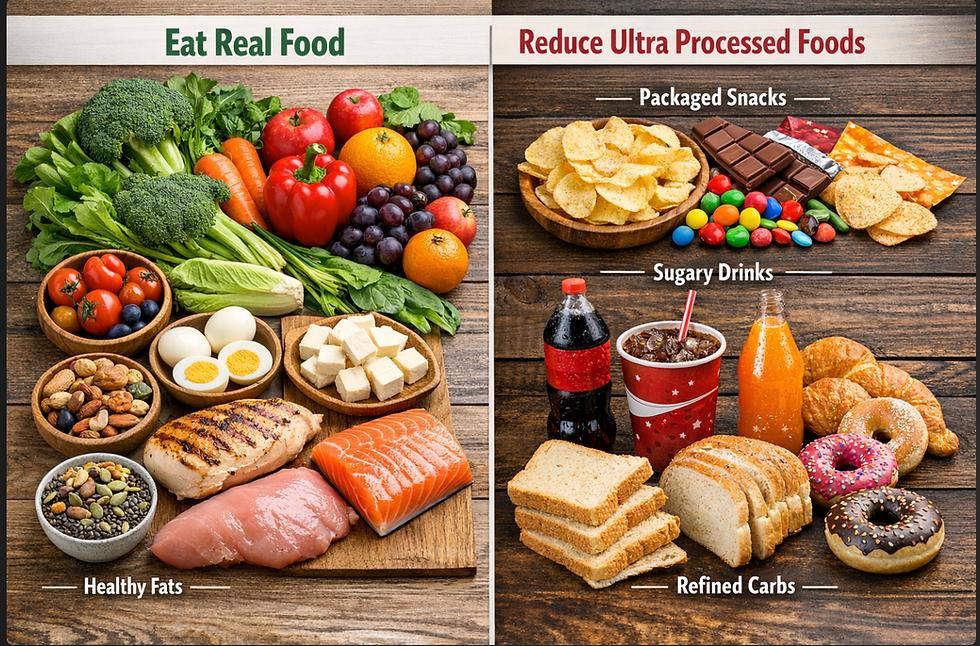
Ultra-processed foods include many packaged snacks, sweetened beverages, confectionery products, instant noodles, ready-to-eat meals, processed breakfast products, and other industrial formulations. They often contain combinations of refined carbohydrates, fats, flavorings, sweeteners, colors, emulsifiers, stabilizers, and other ingredients designed to improve taste, texture, convenience, or shelf life.
The concern is not that every processed food is automatically unhealthy. Processing itself is not new or inherently harmful. Pasteurization, freezing, cooking, fermentation, drying, and canning can improve food safety and preservation.
The bigger scientific question is whether certain characteristics of ultra-processed foods can change appetite, digestion, hormonal signaling, gut microbial activity, eating speed, and metabolic health.
Research increasingly suggests that the answer may involve several interacting mechanisms. A major randomized controlled trial found that people consumed substantially more energy while eating an ultra-processed diet than when eating an unprocessed diet, even though researchers attempted to match several nutritional characteristics of the diets. (PubMed)
At the population level, a 2024 umbrella review covering nearly 9.9 million participants also found associations between greater ultra-processed food exposure and numerous adverse health outcomes, although much of that evidence was observational and therefore cannot by itself establish causation. (BMJ)
So, what could be happening inside the body? 🔬
What Are Ultra-Processed Foods? 🏭
The term “ultra-processed food” is commonly associated with the NOVA classification system, which categorizes foods according to the nature, extent, and purpose of processing.
A useful distinction is that processed does not automatically mean unhealthy.
A plain yogurt may be processed through fermentation. Frozen vegetables are processed by freezing. Canned beans undergo processing that makes them convenient and shelf-stable. Whole-grain bread is also a processed food.
Ultra-processed products are generally industrial formulations made using ingredients or processes that are less typical of traditional home cooking.
Examples can include:
- Packaged sweet snacks 🍪
- Sugary soft drinks 🥤
- Some breakfast cereals
- Instant noodles 🍜
- Candy and confectionery
- Many packaged desserts
- Some ready-to-eat meals
- Processed meat products
- Certain flavored snack products
- Some commercially formulated beverages
However, classification can be complicated. A food’s processing category does not tell us everything about its nutritional value.
Two products can both be classified as ultra-processed while having very different amounts of fiber, sugar, sodium, protein, and energy.
That is why researchers are increasingly interested not only in the label “ultra-processed,” but also in what properties of these foods might affect human physiology.
1. Ultra-Processed Foods May Influence How Much We Eat 🍽️
One of the most important findings in this field concerns appetite and spontaneous food intake.
In a controlled inpatient study published in 2019, researchers at the U.S. National Institutes of Health studied 20 adults who consumed an ultra-processed diet and an unprocessed diet for two weeks each.
The meals were designed to be similar in several nutritional characteristics, including presented calories, macronutrients, sugar, sodium, fiber, and energy density.
Yet participants consumed more calories during the ultra-processed phase. On average, energy intake was about 508 calories per day higher during the ultra-processed diet. Participants also gained weight during that phase. (PubMed)
This experiment was relatively small and short, so it does not answer every question about ultra-processed foods.
But it produced an important insight:
People may not simply overeat ultra-processed foods because they consciously decide to consume more calories. Characteristics of the foods themselves may make greater energy consumption easier.
That shifts the discussion from “How many calories are in this food?” toward another question:
How does this food influence the process of eating?
2. Eating Speed Could Be a Hidden Factor ⚡
One possible explanation is eating speed.
Many ultra-processed foods are soft, highly palatable, and easy to chew or swallow. Some require very little preparation and can be consumed rapidly.
When a person eats quickly, the body has less time to develop the physiological signals associated with fullness.
The stomach and intestine communicate with the brain through mechanical and hormonal signals. As food enters the digestive system, hormones and neural pathways help regulate hunger and satiety.
If a food can be eaten extremely quickly, a person may consume a considerable amount before these signals fully influence behavior.
This does not mean eating quickly automatically causes obesity.
Instead, eating speed may be one piece of a much larger puzzle involving:
texture + palatability + energy density + portion size + appetite + eating speed.
Researchers are continuing to investigate how these characteristics interact.
3. Food Texture Can Change the Way the Body Experiences Food 🥣
Processing can dramatically alter the physical structure of food.
Consider a whole grain compared with a highly refined flour product.
The whole grain retains more of its original cellular structure. Processing can break down or modify that structure, making nutrients and carbohydrates easier to access during digestion.
Similarly, foods that have been ground, milled, extruded, blended, or otherwise physically altered may behave differently in the digestive tract.
This can affect:
- How quickly food is eaten
- How rapidly carbohydrates become available
- How full someone feels
- How much energy is consumed
- How long food remains in the digestive system
The important concept is food structure.
Two foods can contain similar amounts of carbohydrate but have different physical structures and therefore produce different physiological experiences.
This is one reason scientists increasingly recognize that nutrition cannot always be understood by examining isolated nutrients alone.
4. Energy Density May Encourage Passive Overeating ⚖️
Energy density describes how much energy a food provides relative to its weight or volume.
Many vegetables and fruits contain significant water and fiber. As a result, a person can eat a relatively large volume without consuming an enormous number of calories.
Some ultra-processed foods have the opposite characteristics.
They may be:
- Energy dense
- Low in water
- Easy to consume
- Highly palatable
- Convenient
- Available in large portions
Imagine eating a large bowl of vegetables versus eating a handful of an energy-dense snack.
The amount of food occupying the stomach can be very different even if the calorie difference is not immediately obvious.
Energy density therefore influences the relationship between volume, calories, and fullness.
This does not mean every energy-dense food is unhealthy. Nuts, seeds, and some nutritious foods can be energy dense while still being valuable components of a balanced diet.
The overall dietary context matters.
5. Ultra-Processed Foods and Blood Glucose 🩸
Another major area of interest is glucose metabolism.
When carbohydrates are digested, glucose enters the bloodstream. The pancreas responds by producing insulin, which helps cells absorb and use glucose.
The speed at which glucose becomes available can depend on several factors, including:
- The type of carbohydrate
- Fiber content
- Food structure
- Fat and protein content
- Processing
- Cooking
- Individual metabolic differences
Highly refined carbohydrate-rich foods may be digested more rapidly than foods containing intact structures and substantial fiber.
Repeated exposure to dietary patterns dominated by refined carbohydrates and excess energy can contribute to poor metabolic health in susceptible individuals.
Over time, insulin resistance can develop, meaning cells become less responsive to insulin’s signals.
This is one pathway involved in the development of type 2 diabetes.
Large observational research has found associations between higher ultra-processed food consumption and type 2 diabetes. The 2024 BMJ umbrella review reported particularly strong epidemiological evidence for this association, while also emphasizing that observational evidence has limitations. (BMJ)
6. The Gut Microbiome: A Possible Metabolic Middleman 🦠
Perhaps one of the most exciting areas of modern nutrition science is the gut microbiome.
The human digestive tract contains a vast community of microorganisms. These microbes interact with food components and produce metabolites that can influence human physiology.
Diet is one of the major factors shaping the gut microbial environment.
Foods rich in dietary fiber, such as:
🌾 Whole grains
🥦 Vegetables
🍎 Fruits
🫘 Beans
🌰 Nuts and seeds
can provide substrates that gut microorganisms ferment.
One result can be the production of short-chain fatty acids, including acetate, propionate, and butyrate.
These compounds participate in communication between the gut and the rest of the body.
By contrast, dietary patterns dominated by highly refined foods may provide less intact fiber and a different mixture of substrates for the microbiome.
Researchers are studying whether ultra-processed dietary patterns can contribute to changes in microbial composition and function.
However, scientists are still determining exactly which changes are beneficial, harmful, or simply reflective of other dietary differences.
7. Could Food Additives Affect the Gut? 🧪
Ultra-processed foods often contain additives used for texture, preservation, appearance, or stability.
Examples include emulsifiers, stabilizers, sweeteners, colors, and preservatives.
Some laboratory and animal studies have raised questions about whether particular additives could influence the intestinal barrier or microbial environment.
But it is important to avoid jumping from laboratory evidence to definitive claims about human health.
An additive can have one effect at a particular concentration in a laboratory experiment and a very different effect when consumed as part of a complex human diet.
Researchers therefore need controlled human studies to determine whether individual additives meaningfully affect long-term metabolic health.
The broader point is nevertheless important:
Food is not simply a collection of calories. Its physical and chemical structure interacts with the digestive system.
8. The Brain, Reward, and Hyper-Palatability 🧠
Metabolism is connected to the brain.
Food influences reward pathways, motivation, appetite, learning, and behavior.
Some ultra-processed products are formulated to create highly appealing combinations of sweetness, saltiness, fat, aroma, and texture.
These characteristics can encourage repeated consumption.
Think about how different it feels to eat one apple compared with eating a highly flavored packaged snack. The sensory experience is not identical.
The packaged snack may be engineered to provide a particularly intense combination of flavors and textures.
Researchers are studying whether such characteristics can influence appetite and eating behavior.
This does not mean every ultra-processed food is “addictive,” nor does it mean people lack control over their eating.
Human eating behavior is much more complicated.
Environment, stress, sleep, culture, habits, food availability, advertising, income, convenience, and individual preferences all matter.
9. Ultra-Processed Foods May Displace Healthier Foods 🥕
Another mechanism is surprisingly simple.
If someone eats a large amount of packaged snacks, sugary drinks, desserts, and ready-to-eat foods, those foods may displace vegetables, legumes, fruits, whole grains, nuts, and other nutrient-rich foods.
This can affect the overall diet.
A person may consume enough calories while still obtaining inadequate amounts of certain nutrients or dietary fiber.
The BMJ umbrella review noted that higher ultra-processed food consumption is associated with lower intake of some minimally processed foods, including fruits, vegetables, legumes, and seafood. (BMJ)
Therefore, the health effects of ultra-processed diets may come from both:
What they contain
and
What they replace.
10. Metabolism Is More Than “How Fast You Burn Calories” 🔥
The word metabolism is often used casually to describe how quickly a person burns calories.
Biologically, metabolism is much broader.
It includes thousands of chemical processes involved in:
- Producing energy
- Storing energy
- Using glucose
- Processing fats
- Building proteins
- Maintaining cells
- Regulating hormones
- Repairing tissues
- Managing nutrients
Therefore, asking whether ultra-processed foods “change metabolism” does not necessarily mean asking whether they permanently speed up or slow down calorie burning.
A more accurate question is:
Can dietary patterns influence the biological systems that regulate energy intake, glucose control, fat storage, appetite, inflammation, and gut function?
Research suggests that this is a legitimate area of investigation.
11. Why “Beyond Calories” Does Not Mean Calories Don’t Matter ⚠️
This point deserves special attention.
The growing science around ultra-processed foods does not invalidate calorie balance.
If the body consistently receives more energy than it expends, excess energy must ultimately be stored or otherwise accounted for.
Calories remain biologically important.
The more interesting question is why some foods make it easier to consume excess energy.
Imagine two diets with similar calorie targets.
One diet consists largely of foods that are high in fiber, require chewing, have substantial volume, and are eaten slowly.
The other contains many soft, energy-dense, highly palatable foods that can be consumed rapidly.
Even if the theoretical calorie content could be matched, the two diets may produce different experiences of hunger, fullness, and eating behavior.
That is the central idea behind the phrase:
“Beyond calories.”
It doesn’t mean calories disappear.
It means the food environment can influence how calories are consumed and regulated.
12. What Does the Broader Research Say? 📊
The scientific literature has grown rapidly.
A major 2024 umbrella review published in The BMJ evaluated 45 pooled analyses involving approximately 9.9 million participants.
The review found associations between greater ultra-processed food exposure and multiple adverse health outcomes, including cardiometabolic conditions, mental health outcomes, and mortality.
However, the researchers also highlighted an important limitation: much of the evidence came from observational studies, and many of the evidence-quality ratings were low or very low. (BMJ)
This distinction matters.
An association does not necessarily prove that ultra-processed food directly caused a disease.
People who consume more ultra-processed foods may differ in many other ways.
They may have differences in:
- Physical activity
- Sleep
- Income
- Smoking
- Alcohol consumption
- Overall diet
- Access to healthcare
- Stress
- Education
- Existing health conditions
Researchers use statistical methods to account for some of these factors, but no observational study can perfectly eliminate every source of confounding.
This is why controlled trials are particularly valuable.
13. What the NIH Controlled Trial Taught Us 🔬
The 2019 inpatient trial remains one of the most frequently discussed experiments in this field.
Researchers provided participants with ultra-processed and unprocessed diets for two-week periods.
The meals were designed to be closely matched in several nutritional characteristics.
Yet participants ate considerably more calories during the ultra-processed phase—about 508 additional calories per day on average—and gained weight during that period. (PubMed)
Interestingly, the researchers did not identify one simple nutrient responsible for the difference.
This suggests that multiple food properties may have contributed.
Possible factors include:
Eating rate
Food texture
Energy density
Palatability
Appetite signaling
Food structure
This trial therefore shifted attention toward the entire eating experience rather than one isolated ingredient.
14. Are All Ultra-Processed Foods Equally Harmful? 🤔
Probably not.
This is one of the biggest challenges in the ultra-processed food debate.
The category includes a wide range of products.
A sugary soft drink and a fortified packaged food may both fall into a broad ultra-processed category while having very different nutritional characteristics.
Similarly, some products can provide protein, fiber, vitamins, or minerals.
This raises an important scientific question:
Is processing itself the primary problem, or are specific characteristics of many ultra-processed foods responsible for much of the observed risk?
Researchers are still investigating this.
It may eventually become possible to identify which properties matter most.
These could include:
- Excess added sugar
- High sodium
- Low fiber
- High energy density
- Rapid digestibility
- Food texture
- Additives
- Portion size
- Eating speed
- Palatability
The answer may ultimately be more nuanced than simply labeling every packaged food as good or bad.
15. Processed Foods That Can Fit Into a Healthy Diet 🌱
Healthy eating does not require living entirely on foods prepared from scratch.
Convenience foods can be extremely useful.
For example:
Frozen vegetables can make healthy meals easier.
Canned beans can provide an affordable source of plant protein and fiber.
Plain yogurt can be a convenient source of protein.
Whole-grain bread can be practical for busy mornings.
Pre-cut vegetables can save preparation time.
The goal should therefore not be perfection.
Instead, consider whether most of your dietary pattern is built around nutrient-dense foods.
A useful foundation might include:
🥦 Vegetables
🍎 Fruits
🫘 Beans and lentils
🌾 Whole grains
🥜 Nuts and seeds
🥚 Eggs
🐟 Fish or other nutritious protein sources
🥛 Appropriate dairy or alternatives
From there, packaged foods can be incorporated according to individual needs and preferences.
16. Simple Ways to Reduce Ultra-Processed Food Intake 🥗
You don’t have to completely eliminate ultra-processed foods to improve your diet.
Small changes can make a meaningful difference.
Start With Breakfast 🌅
Instead of relying every morning on highly sweetened packaged products, consider combinations such as oats, fruit, nuts, seeds, yogurt, or eggs.
Upgrade Snacks 🍏
Keep convenient alternatives available.
Fruit, nuts, roasted legumes, yogurt, or homemade snacks can reduce reliance on highly processed snack foods.
Drink More Water 💧
Replacing some sugary beverages with water or unsweetened drinks can reduce added sugar intake without requiring complicated dietary changes.
Add Fiber 🌾
Increase vegetables, fruits, beans, lentils, and whole grains gradually.
Fiber supports digestive health and can improve meal volume and satiety.
Read the Ingredient List 🔎
Ingredient lists are not perfect indicators of healthfulness, but they can provide useful information.
Look at the overall nutritional profile rather than becoming frightened by one unfamiliar ingredient.
Cook When Practical 🍳
Home cooking can give you greater control over ingredients, portion sizes, salt, sugar, and fats.
But convenience is also legitimate.
The healthiest diet is one that a person can realistically maintain.
17. The Role of Portion Size and Food Environment 🛒
Individual choices don’t happen in isolation.
Modern food environments make highly palatable foods available almost everywhere.
Large packages, restaurant portions, vending machines, delivery platforms, workplace snacks, advertisements, and convenience stores can all influence eating behavior.
This means that telling people simply to “use willpower” may overlook the environmental factors influencing food intake.
Making healthier foods more accessible and convenient could be an important public-health strategy.
The BMJ umbrella review suggested that the growing evidence provides a rationale for population-level approaches aimed at reducing exposure to ultra-processed foods, while also emphasizing the need for more mechanistic research. (BMJ)
18. Could Personalized Nutrition Change the Conversation? 🧬🤖
The future of metabolic nutrition may become increasingly personalized.
People differ in how they respond to food.
Factors such as genetics, age, activity level, sleep, gut microbiota, insulin sensitivity, body composition, and existing health conditions can influence metabolic responses.
Emerging technologies may allow researchers to combine:
📱 Wearable devices
🩸 Glucose measurements
🧬 Genetic information
🦠 Microbiome data
🥗 Dietary records
🏃 Physical activity data
😴 Sleep patterns
Artificial intelligence could eventually analyze these datasets and identify patterns that are difficult for humans to detect.
Instead of asking:
“Is this food healthy for everyone?”
future nutrition research may increasingly ask:
“How does this food affect this individual within this particular dietary pattern?”
That does not mean personalized nutrition will replace basic healthy eating principles.
It may simply help refine them.
19. What Scientists Still Need to Discover 🔬
Despite enormous interest, many questions remain unanswered.
Researchers still need to determine:
Which components of ultra-processed foods matter most?
Is it the food structure?
The additives?
The combination of sugar and fat?
The low fiber content?
The eating speed?
The energy density?
Or several factors working together?
Scientists also need more long-term randomized controlled trials.
Long-term trials are difficult because participants must follow controlled diets for months or years, which is expensive and challenging.
Therefore, future research will probably combine randomized trials, observational studies, metabolic experiments, microbiome research, and technology-assisted dietary monitoring.
The goal should be to move from broad associations toward a clearer understanding of biological mechanisms.
20. The Bigger Lesson: Think About Food Quality, Not Just Numbers ❤️
The modern nutrition conversation sometimes becomes trapped between two extremes.
One side says:
“Calories are all that matter.”
The other says:
“Calories don’t matter.”
Neither statement provides the complete picture.
Calories are fundamental to energy balance.
But food influences much more than calories.
It affects appetite.
It affects fullness.
It affects eating speed.
It provides fiber.
It interacts with gut microorganisms.
It influences blood glucose.
It provides vitamins and minerals.
It shapes eating habits.
It can alter the food environment around us.
Therefore, a healthier approach is to recognize both sides:
Energy balance matters, and food quality can influence how energy balance is achieved.
Conclusion 🌱
Ultra-processed foods have become one of the most important topics in modern nutrition research because they challenge the idea that food can be understood purely through calorie counting.
The evidence suggests that highly processed dietary patterns may influence metabolism and health through several interconnected pathways, including appetite regulation, eating speed, food texture, energy density, glucose metabolism, gut microbial activity, and food displacement.
A controlled NIH trial provided particularly important evidence that people may spontaneously consume substantially more energy when eating an ultra-processed diet compared with an unprocessed diet, even when several nutritional characteristics are closely matched. (PubMed)
Meanwhile, large observational evidence has linked higher ultra-processed food exposure with numerous health outcomes, although researchers continue to emphasize the limitations of observational research and the need for stronger mechanistic and long-term experimental evidence. (BMJ)
The practical message is not that every packaged product must disappear from your kitchen.
Instead, focus on the overall pattern.
Build meals around vegetables, fruits, legumes, whole grains, nuts, seeds, and nutritious protein sources. Choose minimally processed foods more often when practical, while recognizing that some processed foods can be convenient, affordable, nutritious, and perfectly reasonable parts of a balanced diet.
Most importantly, don’t think about nutrition only in terms of numbers.
Food is information for the body as well as energy. 🧬🥦
The next generation of nutrition research may therefore move beyond the simple question of “How many calories are in this food?” toward a much deeper question:
“How does this food influence the way my body eats, digests, regulates, stores, and uses those calories?”
That shift could transform how we understand metabolic health in the years ahead. 🔬🌍